
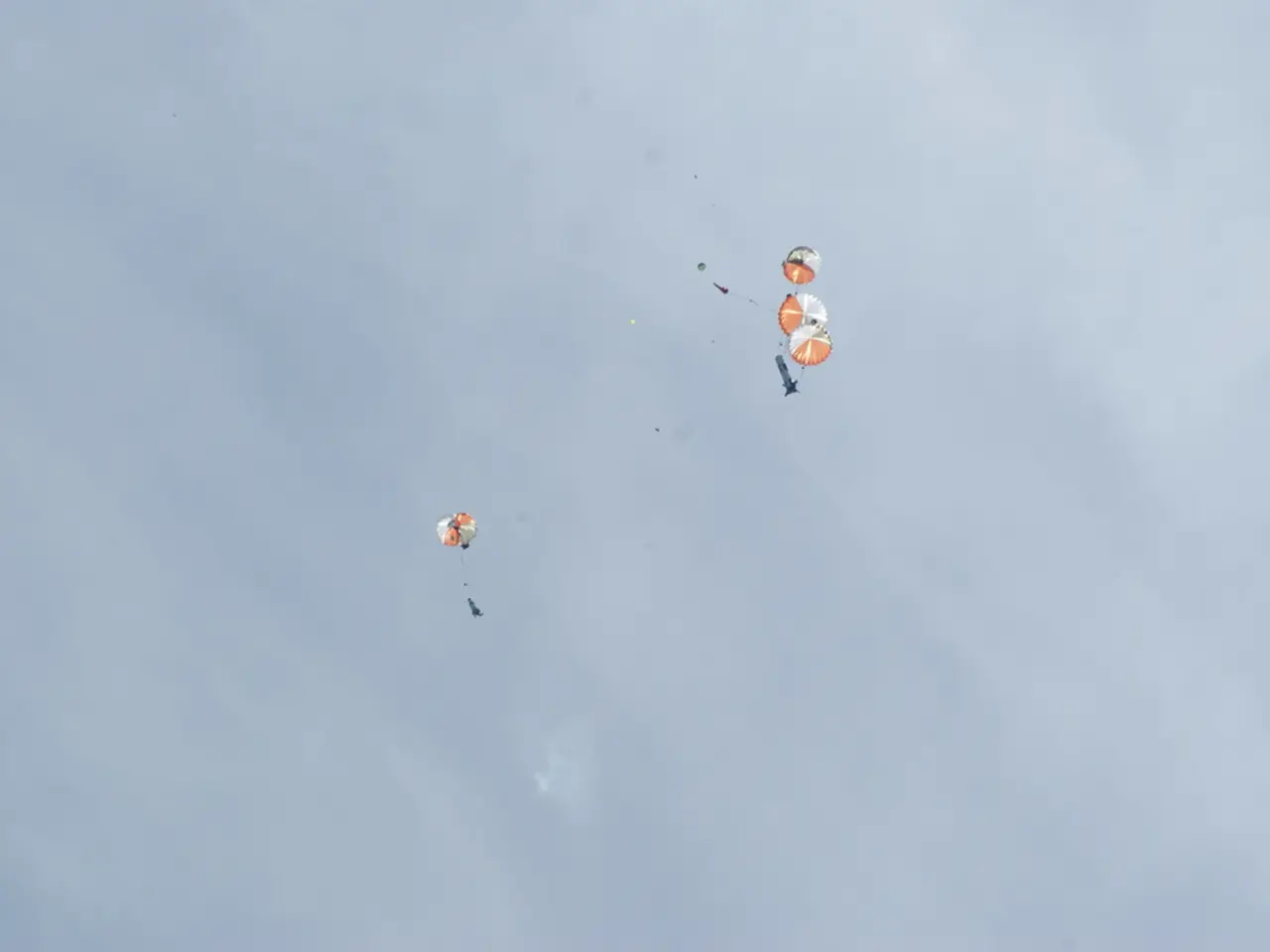
Largest Mars parachute ever tested soars high in the Arctic stratosphere, captured on video (European experiment)
The European Space Agency (ESA) has successfully tested the parachute system designed for its ExoMars mission, marking a significant milestone in the preparations for the 2028 Mars landing. The system, which includes the largest parachute ever designed for Mars, has passed rigorous tests and is now ready for deployment on Mars.
The parachute system, consisting of a 15-meter-wide first-stage chute and a 35-meter-wide secondary chute, is the largest ever designed for a Mars landing. The tests, conducted at Sweden's Esrange Space Center in Kiruna, simulated Mars' thin atmosphere and the descent conditions of the ExoMars landing module.
In July 2025, the parachutes were tested successfully above the Arctic Circle at nearly 30 km altitude using a stratospheric helium balloon. The test involved the parachutes slowing down a mock descent module from near supersonic speed to a safe landing velocity over a sequence of deployments. ESA engineers confirmed the design's readiness and performance after years of development and overcoming previous test failures.
The parachute system is planned to be used for the ExoMars Rosalind Franklin rover, which is now scheduled for launch in 2028 under full ESA funding. The mission was delayed and restructured following the withdrawal of Russian collaboration. ESA is currently awaiting the construction of a new European landing platform to pair with this parachute system.
The U.S. Senate's Appropriations Committee has rejected cuts to the funding for the ExoMars mission in its report published on July 18, providing a boost to the mission's prospects. ESA is closely following discussions regarding NASA's potential withdrawal from the ExoMars mission, as it could cause further delays to the heavily delayed mission.
Luca Ferracina, ESA's ExoMars Entry Descent and Landing Module system engineer, stated that the test is to confirm readiness for Mars and verify the parachutes' performance. The first parachute of the Mars landing assembly will unfurl after about 20 seconds of free fall, as observed during the test.
ESA signed a $194 million contract with Airbus to build the new landing platform for the ExoMars mission. The parachute system had a complicated journey with many test failures before being deemed ready for the planned 2022 launch. Nevertheless, the team's persistence has paid off, and the parachute system is now ready to support the Rosalind Franklin rover's descent to the surface of Mars in 2028.
[1] ESA (2022) ExoMars Parachute System Passes Successful Test. [online] Available at: https://www.esa.int/ExoMars/ExoMars_Parachute_System_Passes_Successful_Test
[2] Space.com (2022) ExoMars Parachute System Successfully Tested for Mars Landing. [online] Available at: https://www.space.com/exomars-parachute-system-successfully-tested-for-mars-landing
[3] Phys.org (2022) ExoMars Parachute System Successfully Tested for Mars Landing. [online] Available at: https://phys.org/news/2022-07-exomars-parachute-system-successfully-tested-mars.html
[4] New Scientist (2022) ExoMars Parachute System Successfully Tested for Mars Landing. [online] Available at: https://www.newscientist.com/article/2323639-exomars-parachute-system-successfully-tested-for-mars-landing/
- The success of the parachute system test for the ExoMars mission, which includes the largest parachute ever designed for Mars, showcases a significant advancement in space-and-astronomy technology, as reported by ESA.
- The European Space Agency (ESA) announced that the parachute system, a crucial component for the ExoMars Rosalind Franklin rover, has been tested and is now ready for deployment on Mars, after years of development and overcoming previous test failures.
- The successful test of the parachute system, designed for the European Space Agency's (ESA) ExoMars mission, marks a significant breakthrough in technology that could potentially revolutionize space-and-astronomy news, as the mission prepares for a 2028 Mars landing.


)