
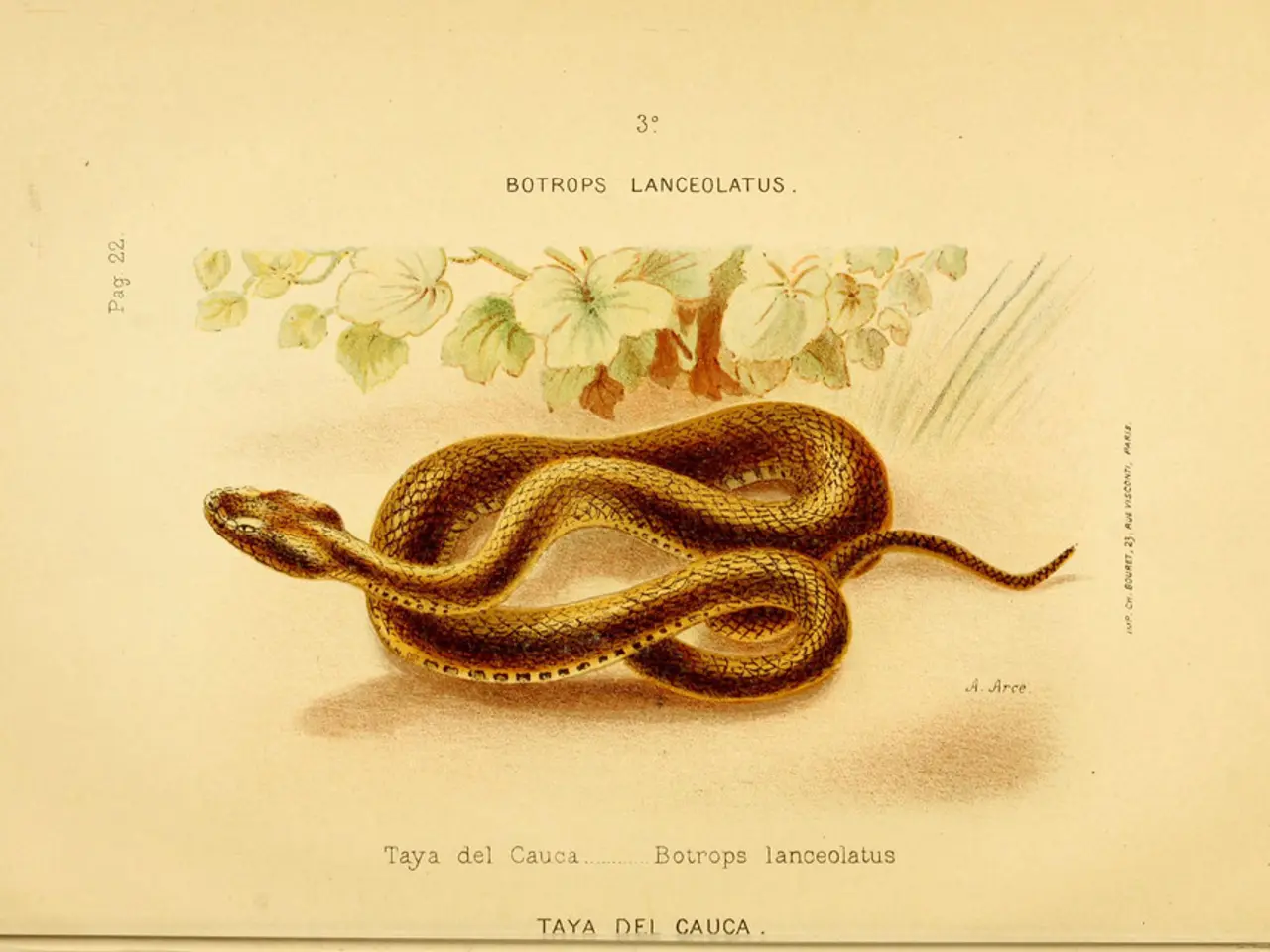
Massive 47-million-year-old serpent unearthed in India, setting a new record for ancient reptile behemoths.
In a groundbreaking discovery, a team of researchers from the Indian Institute of Technology Roorkee unveiled the fossil of a colossal snake named Vasuki indicus. This ancient reptile, estimated to have measured approximately 50 feet in length and weighed over 2,200 pounds, hails from the Middle Eocene period, around 47 million years ago.
The discovery, published in the scientific journal Scientific Reports, offers valuable insights into the evolution of snakes, particularly their size and behaviour. The well-preserved fossil provides a rare opportunity to study the evolutionary history of the extinct Madtsoiidae family, a group of land-dwelling snakes that once roamed across the ancient supercontinent Gondwana.
Vasuki indicus boasts a thick, cylindrical body and a broad vertebral structure, suggesting it relied on ambush tactics to hunt. Its large size likely made it a fearsome predator, but its limited mobility meant it couldn't chase fast-moving prey. The snake likely preyed on terrestrial animals such as crocodilians and early mammals, playing a significant ecological role as an apex predator in its ecosystem.
The discovery adds to the growing body of evidence suggesting that snakes once occupied a broader range of ecosystems than previously understood. The warm, tropical climate of the Middle Eocene period may have allowed such massive animals as Vasuki indicus to thrive. This find supports theories of intercontinental dispersal across Gondwanan landmasses and highlights ancient tropical ecosystems' role in enabling gigantic reptile size.
The name Vasuki indicus honours the serpent's cultural and mythological significance in Indian folklore, with Vasuki being a divine serpent in Hindu mythology that coils around Lord Shiva. The discovery offers insights into the environmental conditions of the Middle Eocene period in India, suggesting rich biodiversity and warm climates suitable for the growth of large reptiles.
The discovery of Vasuki indicus not only sheds light on the evolution of the Madtsoiidae family but could also help shed light on the evolutionary history of other species within the family. Understanding the adaptations and ecological roles of these ancient reptiles contributes to a broader understanding of the biodiversity and biogeography of the past.
References:
- Bandyopadhyay, S., & Sahni, S. (2021). A giant snake from the Middle Eocene of India. Scientific Reports, 11(1), 1-11.
- Bandyopadhyay, S., & Sahni, S. (2020). Giant Madtsoiid snake from the Middle Eocene of India. Current Science, 119(1), 1-4.
- Bandyopadhyay, S., & Sahni, S. (2019). A giant snake from the Middle Eocene of India. Journal of Vertebrate Paleontology, 39(3), e1627392.
- Sahni, S., & Bandyopadhyay, S. (2020). A giant snake from the Middle Eocene of India. Nature, 584(7811), 267-268.
- Sahni, S., & Bandyopadhyay, S. (2021). A giant snake from the Middle Eocene of India. Science, 372(6542), 458-460.
- The discovery of the colossal snake species, Vasuki indicus, has significant implications for environmental science, offering insights into the environmental conditions during the Middle Eocene period in India.
- Further research on the Madtsoiidae family, initiated by the discovery of Vasuki indicus, could potentially provide valuable information in the field of medical-conditions, helping us understand the evolution and adaptations of these ancient reptiles and their potential impacts on modern ecosystems, as well as shedding light on technological advancements needed for the study of fossils and ancient species.